Renal Nutrition
GLP-1s and CKD: What to Eat on Ozempic, Wegovy, or Mounjaro to Protect Your Kidneys — and Your Muscle
Something changed in nephrology in the last two years. Semaglutide stopped being a drug that kidney patients happened to be on and became a drug kidney patients are put on — after the FLOW trial found that it reduced major kidney events and slowed the decline in eGFR in people with type 2 diabetes and CKD, with a roughly 24% reduction in the primary kidney outcome [1]. Guideline bodies moved quickly, and GLP-1 therapy now sits alongside SGLT2 inhibitors and RAS blockade in the standard kidney-protection toolkit [2].
What nobody handed you with the prescription is the nutrition plan. These medications work in large part by slowing stomach emptying and blunting appetite, so intake falls across the board — not just the calories you wanted to lose. In body-composition analyses of the major trials, a substantial share of the weight lost was lean mass rather than fat: about 39% of total weight loss in the semaglutide STEP 1 substudy, and roughly a quarter with tirzepatide in SURMOUNT-1 [3][4]. In a population already at risk for protein-energy wasting, that number deserves a plan.
Why kidney patients are being prescribed these now
For years the kidney benefit of GLP-1 drugs looked like a side effect of better blood sugar and blood pressure. Pooled analyses of cardiovascular outcome trials then showed a consistent reduction in kidney endpoints, mostly driven by less albuminuria [5]. FLOW was the first trial designed to test kidney outcomes directly, and it was stopped early for efficacy [1].
The real risk: you eat less of everything
Appetite suppression is not selective. When total intake drops by a third, protein drops by a third, fluid drops with it, and so do potassium, magnesium, and B vitamins from food. In the general population that's tolerable. In CKD it collides with a condition nephrology already spends a lot of energy preventing: protein-energy wasting, the loss of muscle and body protein stores that independently predicts worse outcomes in kidney disease [6].
Your protein target on a GLP-1
This is where CKD makes the advice different from every general GLP-1 article you'll read. The mainstream recommendation for protecting muscle during weight loss is 1.2–1.6 g of protein per kg of body weight per day. That number is not automatically safe in CKD, where KDOQI guidance for non-dialysis stages 3–5 without diabetes is 0.55–0.60 g/kg/day of protein, and 0.6–0.8 g/kg/day when diabetes is present, with dialysis patients needing considerably more at 1.0–1.2 g/kg/day [9]. Those targets are calculated on ideal, not actual, body weight.
The practical resolution is not to pick a side. It is to sit at the top of your prescribed range rather than drifting toward the bottom because you aren't hungry, to make every gram of that protein high-quality, and to spread it across the day so your muscle actually gets the signal to rebuild [7].
| Your situation | Guideline protein range | On a GLP-1, aim for |
|---|---|---|
| CKD stage 3–5, not on dialysis, no diabetes | 0.55–0.60 g/kg IBW/day | The top of the range, not the bottom. Do not exceed it to chase muscle — ask about a monitored plan instead. |
| CKD stage 3–5 with diabetes | 0.6–0.8 g/kg IBW/day | Top of range, split into three feedings of roughly equal size. |
| On hemodialysis or peritoneal dialysis | 1.0–1.2 g/kg IBW/day | Hit it every day, including non-dialysis days. This is the group most likely to fall short on a GLP-1. |
| Kidney transplant, stable function | 0.8–1.0 g/kg/day (individualized) | Toward the upper end while actively losing weight; coordinate with your transplant dietitian. |
| CKD stage 1–2, normal-range eGFR | ≈0.8 g/kg/day baseline | 1.0–1.2 g/kg/day is often reasonable during active weight loss — confirm it with your team first. |
Hydration when you're never thirsty
Appetite and thirst fade together, and the gastrointestinal side effects of these medications — nausea, vomiting, and diarrhea are the most common adverse reactions in the labeling — pull fluid out at the same time [10]. That combination is why acute kidney injury and volume depletion appear in the prescribing information for semaglutide, most often in people who developed nausea, vomiting, or diarrhea and became dehydrated [11].
Now layer on the medications a kidney patient is usually already taking. A diuretic is actively removing fluid. An SGLT2 inhibitor adds ongoing glucose-driven urine loss. An ACE inhibitor or ARB removes some of the kidney's ability to defend its own filtration pressure when volume drops. None of these is a reason to stop anything — but together they mean a stretch of poor intake is a medical situation rather than an inconvenience [2].
Don't wait to feel thirsty
Thirst is a late and unreliable signal at the best of times, and a GLP-1 makes it later. Drink on a schedule instead — a set amount with each medication dose and each meal.
Don't free-drink to compensate
If you're on a fluid restriction for stage 4–5 CKD or dialysis, the answer to nausea and poor intake is not to drink more. It's a same-day call to your team for a temporary plan.
Don't rely on sports drinks
They're high in sugar, and many are meaningfully high in potassium — the wrong combination when your intake is already erratic and your labs are drifting.
Don't push through repeated vomiting
More than a day of vomiting or diarrhea on a GLP-1 with a diuretic, an ACE/ARB, or an SGLT2 inhibitor is exactly the scenario sick-day guidance was written for. Call before you're depleted [2].
Renal Nutrition
Hydration in CKD: How Much Water Is Actually Right?
How to set a personal fluid target by CKD stage — the framework to build your GLP-1 schedule inside.
Read the article →Renal Nutrition
SGLT2 Inhibitors and CKD: What to Eat on Jardiance, Farxiga
If you're on Jardiance or Farxiga alongside a GLP-1, the fluid and sick-day rules stack.
Read the article →Eating well when three bites feels like a meal
The tactical problem on a GLP-1 is volume: your stomach empties slowly, so you fill fast and stay full for hours. Fighting that with willpower doesn't work. Changing the density of what you eat does.
1 · Protein first
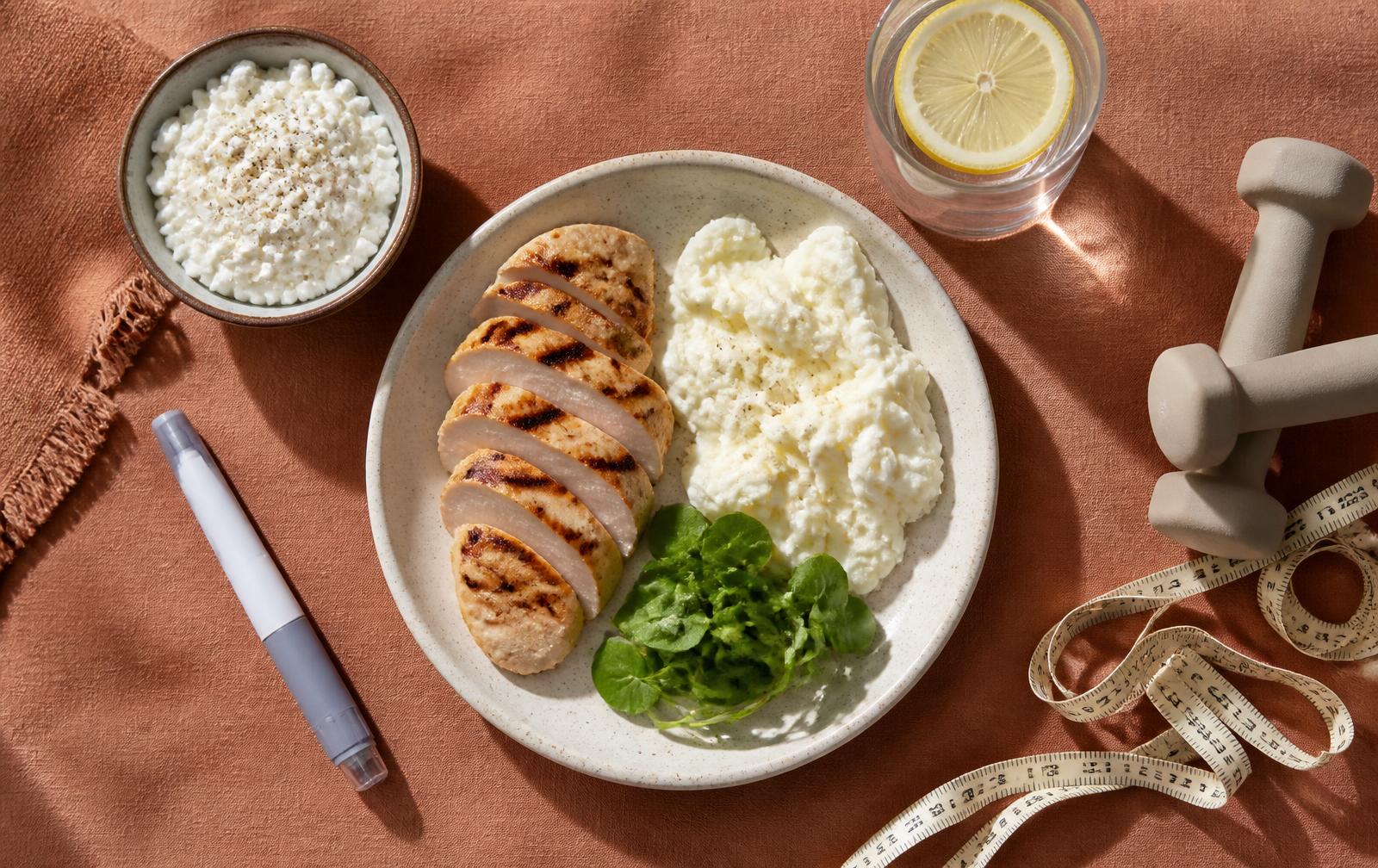
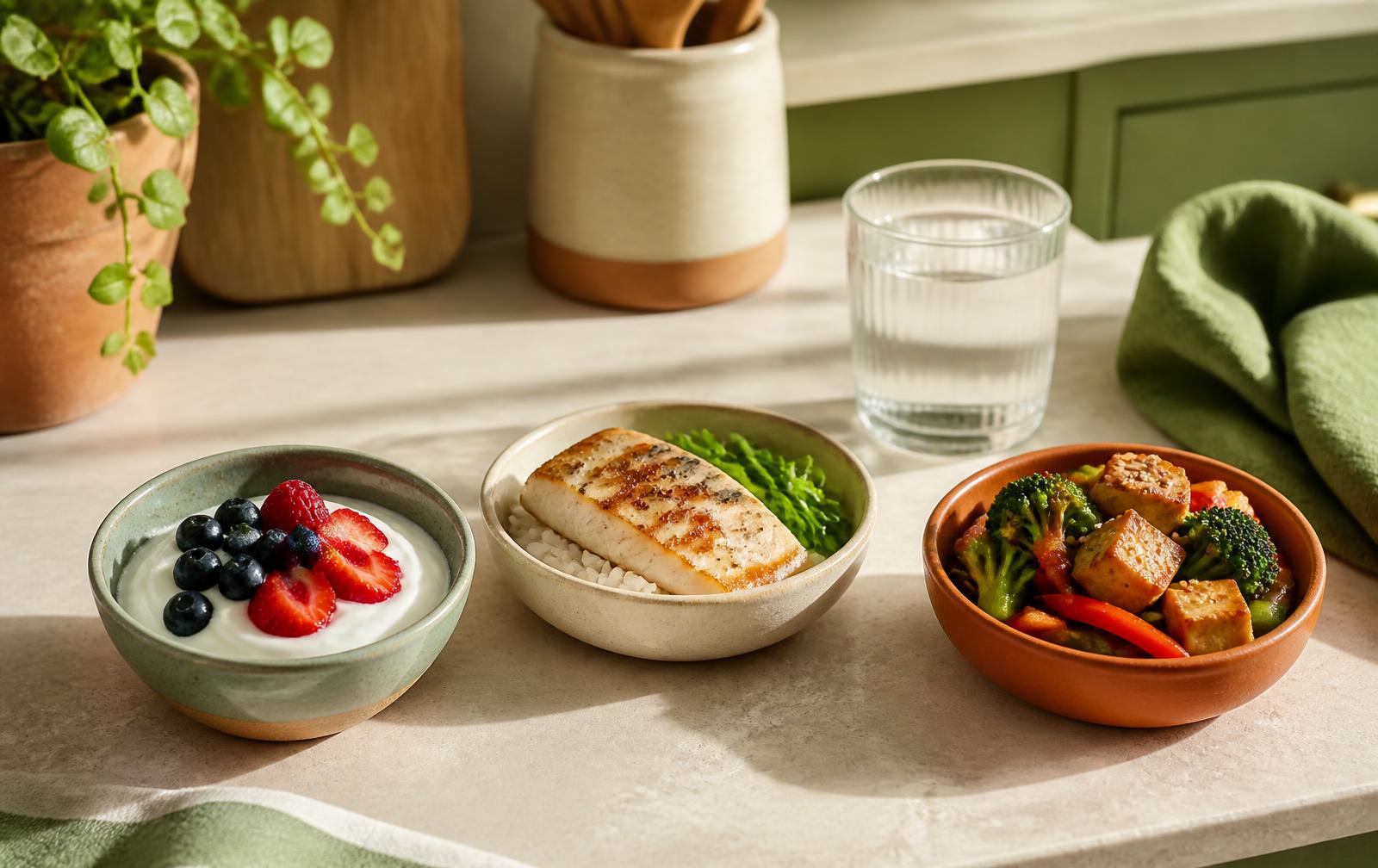
Eat the protein portion before anything else on the plate. Fish, eggs, chicken, tofu, or Greek yogurt — whichever you can face that day. If fullness arrives after four bites, at least those bites were the ones that count.
2 · Keep the portion small and the plate small
A dinner plate of food is discouraging when you're not hungry, and a discouraging plate gets abandoned. A side plate with a realistic portion gets finished — which is the actual goal.
3 · Add a kidney-appropriate carbohydrate
White rice, pasta, couscous, or bread are useful here: energy without the phosphorus and potassium load of whole-grain and bran-heavy options, which matters more the further along your CKD is [9].
4 · Cook the vegetables and go easy on volume
Cooked vegetables take up far less room than a raw salad for the same nutrition. If you're managing potassium, this is also where leaching and portion size do their work.
5 · Drink between meals, not during
Fluid with a meal fills the space you need for protein. Shift most of your drinking to the gaps between feedings.
6 · If a meal is a write-off, make it liquid
On nausea days, a small protein shake goes down when food won't. Choose one appropriate for your stage — check the phosphorus additives and potassium, and ask your dietitian which product fits your labs.
| Option | Portion | Why it works on a GLP-1 |
|---|---|---|
| Egg whites + 1 whole egg | 4 whites + 1 egg | Low phosphorus, soft texture, tolerated when nausea is present |
| Chicken or turkey breast | 3 oz | Highest protein per bite of the common options; keep the portion small and moist |
| Cod, tilapia, or salmon | 3 oz | Soft, quick to cook, no chewing fatigue; salmon adds omega-3s |
| Greek yogurt, plain | 3/4 cup | Cold and easy on a nausea day; higher in phosphorus, so watch it in stage 4–5 |
| Firm tofu | 5 oz | Plant protein with a lower phosphorus absorption rate — useful in advanced CKD |
| Cottage cheese, low-sodium | 3/4 cup | Fast, no cooking; only choose a low-sodium version |
| Renal-specific oral nutrition drink | 1 carton | Designed for CKD electrolyte limits; the fallback when solid food fails |
Renal Nutrition
Low-Phosphorus Diet for CKD: A Nutrition Researcher's Guide to Hidden Phosphate Additives
How to spot phosphate additives on a label — essential when you start leaning on shakes and bars.
Read the article →Renal Nutrition
Plant-Based Protein for CKD: How Much Is Safe and How to Get Enough
Plant protein absorbs less phosphorus, which makes it useful when your protein budget is tight.
Read the article →Kidney-Friendly Recipes
7-Day Kidney-Friendly Meal Plan for Stage 3 CKD (With Grocery List)
A worked week of meals you can shrink into GLP-1-sized portions.
Read the article →Protecting muscle: the part food can't do alone
Protein is necessary but not sufficient. In trials of weight loss maintenance, the combination of exercise and a GLP-1 preserved lean mass and produced better body composition than either alone — the drug plus training group kept muscle that the drug-only group lost [8]. Resistance training is the signal; protein is the raw material. You need both.
Two sessions a week is the floor
Not two hours. Twenty minutes of resistance work twice a week is enough to change the trajectory, and it's a target you'll actually keep on a low-appetite week.
Bands and bodyweight count
Sit-to-stands from a chair, wall push-ups, and a resistance band are legitimate resistance training. Dialysis patients can often do band work seated during treatment — ask your unit.
Put protein near the session
A protein feeding within a couple of hours of training makes better use of what you ate. On a GLP-1 that often means training before a meal you were going to eat anyway.
Track something other than the scale
How many sit-to-stands in 30 seconds, or whether the stairs feel easier. The scale can't tell you what kind of weight you lost.
Clear it first if you have heart or access considerations
Especially with a dialysis access, uncontrolled blood pressure, or recent transplant — get the specific go-ahead before starting.
Labs and medications to keep an eye on
A GLP-1 changes your intake fast, and your medication doses were set for the old intake. Diabetes medications in particular often need to come down as weight falls and eating drops off, and current diabetes standards of care build in that reassessment [12]. This is a period for closer monitoring, not the usual six-month rhythm.
| What | Why it changes on a GLP-1 | Reasonable timing |
|---|---|---|
| eGFR and creatinine | Volume depletion from nausea or vomiting can drop kidney function acutely | 2–4 weeks after each dose increase, or promptly after any illness |
| Potassium | Intake, medications, and fluid status all shift at once | With each kidney panel; sooner if you've had days of vomiting or diarrhea |
| Albumin and weight trend | Falling albumin plus fast weight loss is the early picture of protein-energy wasting | Every visit; flag weight loss faster than 1–2 lb a week |
| Blood glucose / A1c | Insulin and sulfonylurea doses frequently need reducing to avoid lows | As directed — do not wait if you're having hypoglycemia |
| Blood pressure | Weight loss plus reduced intake often makes existing BP medication too strong | Home readings; report dizziness on standing |
| UACR | The kidney benefit shows up here first | Per your nephrologist's schedule, typically every 3–6 months |
Renal Nutrition
Protein Needs in Dialysis vs Pre-Dialysis CKD
Why the protein target flips at dialysis — critical if you're on a GLP-1 and starting treatment.
Read the article →Renal Nutrition
Cardiovascular-Kidney-Metabolic Syndrome: What to Eat
The heart-kidney-metabolic picture these medications are usually prescribed inside.
Read the article →Renal Nutrition
Potassium and Kidney Disease: Foods to Limit and Foods That Are Actually Safe
Where potassium comes from when your intake is small and irregular.
Read the article →References
- 1.Perkovic V, Tuttle KR, Rossing P, et al. Effects of semaglutide on chronic kidney disease in patients with type 2 diabetes (FLOW). N Engl J Med. 2024;391(2):109–121. Read source ↗
- 2.KDIGO 2024 Clinical Practice Guideline for the Evaluation and Management of Chronic Kidney Disease (including sick-day medication guidance). Read source ↗
- 3.Wilding JPH, Batterham RL, Calanna S, et al. Once-weekly semaglutide in adults with overweight or obesity (STEP 1). N Engl J Med. 2021;384(11):989–1002. Read source ↗
- 4.Jastreboff AM, Aronne LJ, Ahmad NN, et al. Tirzepatide once weekly for the treatment of obesity (SURMOUNT-1). N Engl J Med. 2022;387(3):205–216. Read source ↗
- 5.Sattar N, Lee MMY, Kristensen SL, et al. Cardiovascular, mortality, and kidney outcomes with GLP-1 receptor agonists in patients with type 2 diabetes: a systematic review and meta-analysis. Lancet Diabetes Endocrinol. 2021;9(10):653–662. Read source ↗
- 6.Carrero JJ, Stenvinkel P, Cuppari L, et al. Etiology of the protein-energy wasting syndrome in chronic kidney disease: a consensus statement from the International Society of Renal Nutrition and Metabolism. J Ren Nutr. 2013;23(2):77–90. Read source ↗
- 7.Bauer J, Biolo G, Cederholm T, et al. Evidence-based recommendations for optimal dietary protein intake in older people: a position paper from the PROT-AGE Study Group. J Am Med Dir Assoc. 2013;14(8):542–559. Read source ↗
- 8.Lundgren JR, Janus C, Jensen SBK, et al. Healthy weight loss maintenance with exercise, liraglutide, or both combined. N Engl J Med. 2021;384(18):1719–1730. Read source ↗
- 9.Ikizler TA, Burrowes JD, Byham-Gray LD, et al. KDOQI Clinical Practice Guideline for Nutrition in CKD: 2020 Update. Am J Kidney Dis. 2020;76(3 Suppl 1):S1–S107. Read source ↗
- 10.Filippatos TD, Panagiotopoulou TV, Elisaf MS. Adverse effects of GLP-1 receptor agonists. Rev Diabet Stud. 2014;11(3):202–230. Read source ↗
- 11.Novo Nordisk. OZEMPIC (semaglutide) injection — FDA prescribing information, warnings on dehydration and acute kidney injury (DailyMed). Read source ↗
- 12.American Diabetes Association. Standards of Care in Diabetes — pharmacologic approaches to glycemic treatment and obesity management. Read source ↗
About the author
Swetha Raju
Columbia M.S. Candidate in Clinical Human Nutrition · AKF Certified Kidney Health Coach · NKF Medical Advisory Committee (MAC) Member · NKF peer mentor · CKD patient advocate · Published chronic disease and nutrition researcher
Swetha Raju is the founder of NephroNourish. As a published researcher and lifelong chronic disease patient, she translates renal nutrition and metabolic science into practical guidance people can actually use.
A note on scope. This article is educational and not individual medical advice. Always discuss changes with your nephrologist, dietitian, or care team.